Dood-e Fam (Carbon Black) Company, as a major player in the chemical and energy industries, faced a serious challenge with its 10-inch gas pipelines. During periodic inspections, it was found that 250 meters of the company’s gas transmission pipeline suffered from both uniform corrosion over its length and severe localized corrosion at specific points. These damages not only threatened the operational safety of the pipeline but also increased the risk of gas leaks and disruption to the production process.
The uniform corrosion was caused by the gradual erosion of the pipe’s surface due to continuous contact with moisture, chemicals, and environmental factors, while the severe localized corrosion resulted in the creation of deep pits in specific areas of the pipeline. To solve this problem, a combined approach was needed to both repair the critical areas and prevent the spread of corrosion in the future.
After technical reviews, the decision was made to execute the repair project in two main stages: first, repair of critical points with composite coatings for deep pits and areas with severe corrosion; and second, advanced insulation using resistant tapes for sections with superficial corrosion.
This method not only reduced the costs of complete pipe replacement but also allowed for the rapid return of the pipeline to the production cycle without disrupting company operations. This project is a successful example of applying modern repair technologies in heavy industries, highlighting the importance of preventive maintenance and the use of resistant materials in increasing the lifespan of equipment. The following sections will detail the project’s execution stages, challenges, and achievements.
Identified Problems
Severe Localized Corrosion
The formation of deep pits at specific points due to environmental or chemical factors.
Uniform Corrosion
General erosion of the pipe surface over a length of 250 meters.
Pipeline Inspection, Repair, and Protection Process: From Detection to Execution
Precise Engineering in Critical Distances
The crossing of a 12-inch fire-fighting pipe beneath a gas pipe with minimal clearance is an example of an engineering challenge that can be best solved through meticulous planning and adherence to standards.
Uncovering Hidden Layers: From Asphalt to Concrete
Digging up asphalt to identify the concrete slabs covering the pipelines is a necessary step in the inspection and repair of critical infrastructure.
Critical Angles: The Pipe's Condition at the Bend and Under the Asphalt
Examining the condition of the pipe at the bend and the section running under the asphalt is a key step in evaluating the health and safety of pipelines.
Environmental Challenges: Pipe Probing in a Waste Disposal Area
Probing pipelines in a waste disposal area requires advanced technologies to detect damage and prevent the leakage of hazardous materials.
Line Voltage: The Key to Safety Before Insulation
Measuring the line voltage before starting the insulation process is an essential step to ensure the safety and efficiency of the operation.
The Humidity Challenge: Gas Valve Chamber and Uninsulated Pipes
A gas valve chamber with high humidity and uninsulated pipes requires inspection and immediate action to prevent corrosion and potential damage.
Pipe Coating and the Corrosion Challenge: Inspecting the Surface Condition
Inspecting the condition of the pipe coating and its surface for corrosion is an essential step to maintain safety and increase the lifespan of pipelines.
Securing the Work Site: Visual Warnings for Hazard Prevention
The use of safety signs and yellow caution tape in the trench and work site is an essential step to ensure the safety of employees and prevent accidents.
From Decay to Repair: The Condition of a Pipe at Risk
The corroded condition of a pipe indicates the need for immediate action to prevent leaks, further corrosion, and other potential damage.
After Rust Removal: Pipes Ready for Future Challenges
The condition of the pipe after rust removal and cleaning ensures optimal performance and an increased lifespan for the pipelines.
Surface Cleanliness: The Key to Successful Primer Application
Dusting with a cleaning cloth before applying the primer ensures that the pipe surface is free of any contamination and ready for coating.
From Primer to Tape Wrapping: The Stages of Pipe Preparation
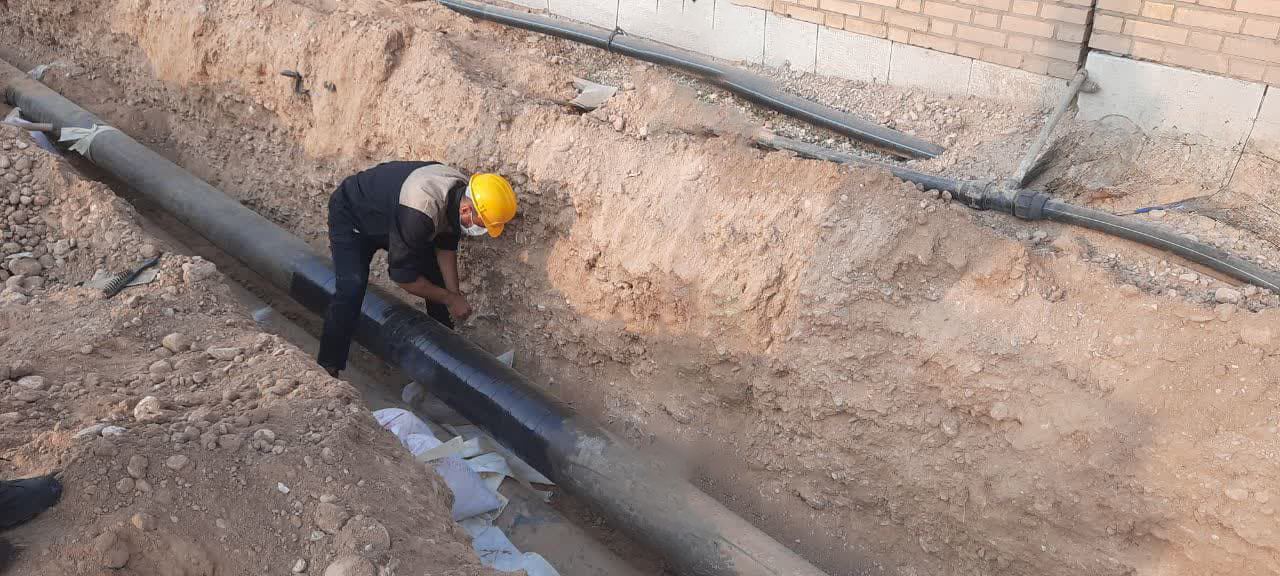
Applying primer before tape wrapping is an essential step for creating a uniform surface that is resistant to corrosion.
Tape Wrapping: Reliable Protection for Pipelines
The operation of tape wrapping is an effective method for protecting pipelines against corrosion and environmental damage.
Pipe Thickness Measurement: Gauging for Safety and Durability
Pipe thickness measurement is a precise method for evaluating the health of the pipe and preventing risks resulting from a reduction in wall thickness.
Gas Valve Chamber Outlet: Challenges of Uninsulated Pipe
The condition of the pipe at the gas valve chamber outlet and the construction of the chamber wall on the uninsulated pipe require inspection and immediate action to prevent corrosion and potential damage.
Holiday Test: Checking Coating Quality Before Backfilling
Using a holiday detector to test the pipe coating before backfilling ensures the quality and integrity of the protective coating.
Corrosion of the welds in the section after the gas chamber
Pipe corrosion in the sections where the chamber wall was built around the pipe
Project Results
Complete Rehabilitation of 250 Meters of Pipeline
Without the need for replacement.
Elimination of Severe Localized Corrosion
Using composite coatings.
Cost Reduction
Compared to traditional pipe replacement methods.
Increased Pipeline Lifespan
Up to 50 years with resistant insulation.


Conclusion
This project not only demonstrates Manshoor Composite Sanat Asia Company’s ability to manage complex industrial challenges but also serves as proof of the effectiveness of combining modern technologies (composites and insulation) in the oil and gas industry. By reducing costs and increasing safety, this method is put forward as a model for similar projects in the future.